Moved Mountains

Banner - Mt Trio, Stirling Range National Park, Western Australia - (c) 2007
Showing posts with label mission. Show all posts

Wednesday, November 19, 2008

Congo Trouble

The situation in the Congo is desperate for thousands of people now flooding the Internally Displaced Persons (IDP) camps in and around the city of Goma in the north east of the country (the North Kivu region).

I have managed to make contact, through Claude Nikondeha of Amahoro Africa, with a church in Goma that is dealing directly with the thousands of people (including many children separated from their families and at the mercy of unscrupulous predators). I am currently working with my colleagues in Rwanda to find a way of getting humanitarian aid (blankets, clothing and food) accross the border into Goma and will post more details of this, and ways you can help support this effort, in the very near future.

In the meantime, and as you read the excerpts from my communication with a Congolese pastor, please continue to pray for the situation and those affected.

Dear Andrew,

Shalom from Goma. How encouraging and how good to be in the family of God's people! ... Your email is a relief in itself. It gives me joy to serve our IDPs who come desperately from the fighting areas. Praised be the name of our living and comforting God. We are fine in the Lord, my family and I. We are in the town of Goma even though the threat is big, the Lord has assured us of His presence and protection.
We are safe and serving our people in the town of Goma and around Goma. We are doing the little He enables us to do. Some times we feel discouraged, sometimes you find low spiritually when you see Innocent people, created at God's image suffer such a kind of injustice. But yours prayers have lifted us.
... since the first day, our church have been active in active ministry to the IDPs. We are collecting clothes, food for them and then our church building and schools hosted them. In the day they are outside... But with time we have been overwhelmed as the war continues to take other dimensions. For hospitality sake many are hosted in families

As a church, we are using our church medical centers to care for them when they are sick. As a church we are also involved in trauma healing and peace building especially at this time when hatred can arouse from the hurting innocent people. My church has appointed a Crisis committee at this time and I am heading the committee. We meet every day to see what is happening and what is needed to be done and where. Pray for us.

The problem we are facing is that all the supplies are becoming expensive that almost all the families are suffering the consequences because rebels have cut Goma from most of the centers we get most of the items from.The needs are as follows: Food, medecines, blankets, clothes.
As for us as a family, it is only food that we need.
But above all, pray for us, for the country, for the international community that seems for close the eye on what is happening in East Congo. The just judge will bring justice and light to this suffering. Send messages of courage and comfort. We need them
I love you even though we have never met. I also bless you. Shalom. Because He lives, we can face tomorrow

Yours in His love
More soon.

Monday, October 13, 2008

Ugandan Connection


Lyss and I have had a friend from Uganda staying with us for the last week. Alyssa and I met Paul Kiviiri at the Amahoro Gathering in Kigali in May.

For the past 10 years Paul has been working to build bridges across tribal divides and establish new forms of church among southern Uganda's marginalised, nomadic Tutsi tribes people.

The tribal culture prevalent throughout Africa makes this kind of work difficult. It also creates many of the problems we hear about in the west and associate with politics. It is virtually unheard of, even in the Ugandan church, for relationships and ministry to extend beyond the tribal lines.

Paul says it took him 5 years to build the trust of the nomads he is involved with and he still struggles to gain understanding from the other local church leaders for his approaches to church (I can relate to that!).

The churches Paul has been involved in developing following the nomadic people around. They are not fixed to a place and they seek to meet the real day to day needs of those they are formed from. A big part of Paul's work is training up the leaders, many of whom are illiterate, and helping them to impart the way of Jesus to their fellow tribes people. He is also having to tackle issues such as bride-selling, polygamy and traditional spiritual beliefs.

Paul himself knows, as most African's do, what it is to struggle. He was born into a polygamist family during Idi Amin's reign and spent much of his teenage years as a street kid. Even though life was difficult he managed to put himself through school and train as a primary school teacher before becoming a youth pastor in a Kampala church. His heart has always been with the people though and he made the choice to leave the institutionalised church behind in order to pursue a ministry that would break down tribal barriers and share the love of Christ for all African people in meaningful and culturally relevant ways.

It's been a great privilege to have had Paul with us this past week and for him to meet and spend time with the people we are involved with her in the South West.

Paul's story is another example of the way God is working around the globe to revolutionise mission and to move His church into a new era.

Tuesday, July 15, 2008

Rwanda and Amahoro Africa 2009 - The "Emerging" church on the African Continent

If you've ever thought about visiting Africa and experiencing life and faith of the locals there's no better time than 2009.

Visit Africa
Make a Difference
Change your life

Day 4 (the aid and development organisation I manage) are teaming up with Amahoro Africa to offer a package that includes the 2009 Amahoro Africa Gathering in Johannesburg, South Africa and a couple of weeks on the ground in Rwanda. A package is also available through Day 4 that features the Gathering only.

We have around 10 places available for the combined package so please, if you're interested contact me ASAP. If you know others who may also be interested please share this information around.

Amahoro Africa Gatherings are an amazing time of connecting with emerging leaders from Africa and around the world, of learning and being inspired by the work of God among his people in Africa and beyond. Speakers include Claude Nikondeha (you can read more about Claude in McLaren's new book, Everything Must Change), Brian McLaren (author of The Secret Message of Jesus, Church on the Otherside and other best selling books), Richard Twiss (Native American activist, author and theologian) and many other inspiring African leaders - some like Edward Simiyu have featured on Moved Mountains in the recent past.

You can read all about the Gathering on the Amahoro website and about the Day 4 Community Aid & Development side of things at the Day 4 site.

Friday, July 04, 2008

Exilio

I've started going through the Exilio program with our small group. Exilio has grown out of Mike Frost's book Exiles (incidentally, a great and in some ways challenging read) and uses an action and reflection approach to learning - so along with some hefty reading exercises, and Bible study, there's also some practical home work which Mike refers to as "missional experiements" (this has most of the group cringing).

One of the exercises given in the "Bible study" part of the course is to begin reading through the Book of Acts - in a public place. Some of the group first thought this was a missional exercise in itself. Thankfully it isn't - not that I have any problem with people reading their Bibles in public, rather says Mike, the public reading is about bringing the text of Acts to life:

When we read Acts in public spaces our imagination cannot help but ask the question, "What would it look like if the Book of Acts happened today in this cafe. park, train station, shopping mall?". We find reading the Bible surrounded by people who are yet to discover God's love deeply affects our understanding of the reading. (Ignition, p.7)
I put this to the test today. I was supporting a young member of our Bunbury community (Alternate[Or]) during a court appearance and had plenty of time up my sleeve while waiting for his case to be called. So I read the first 2 chapters of Acts in the courthouse. At first I thought the whole "public reading" thing sounded a bit wussy, but, in reflection, I think it did, to some degree at least, affect how I viewed the text. Particularly the section describing Peter's address to the Jews and Jewish converts at Pentecost. The bit that really jumped out and grabbed me was the following:
Now when they heard this they were cut to the heart, and said to Peter and the rest of the apostles, "Brothers, what shall we do?" And Peter said to them, "Repent and be baptized every one of you in the name of Jesus Christ for the forgiveness of your sins, and you will receive the gift of the Holy Spirit. For the promise is for you and for your children and for all who are far off, everyone whom the Lord our God calls to himself."

And with many other words he bore witness and continued to exhort them, saying, "Save yourselves from this crooked generation." So those who received his word were baptized, and there were added that day about three thousand souls. And they devoted themselves to the apostles' teaching and fellowship, to the breaking of bread and the prayers. And awe came upon every soul, and many wonders and signs were being done through the apostles. And all who believed were together and had all things in common. (ESV)
Particularly given my location at the time I was hit (again) by the important place repentance holds in the ordo salutis (order of salvation). It made me think about the young bloke I was with and his genuine interest in Christ and his life and what it would mean for him to become a disciple. It also made me think about the sheer lack of anything even resembling repentance I have seen in my many visits to the courthouse over the last 10 years or so (not to mention my own appearances before the Magistrate when I was a younger man!).

Thankfully today's result was a good one for my young friend. A reprieve that will hopefully help the process of repentance and forgiveness along.

As for the practical side of Exilio I think I have plenty of things to choose from without having to dream up a whole new missional experiment.

Sunday, June 15, 2008

Blog Wrap - Week 1

I use Bloglines to keep up-to-date with my favourite blogs. For those who don't know, Bloglines is a blog reader. It takes all of the latest posts from the blogs you tell it to access and collates them all in one place. It makes it quick and easy to get the latest news from your favourite bloggers.

Bloglines also allows you to save posts for future reference.

Something I've been meaning to do for a while is link to some of the many interesting posts I've saved in my Bloglines account. They date back a while, and I have quite a collection happening, but, thought that I would start sharing them around with a regular "Blog Wrap".

So here goes - this weeks interesting blog snippets are:

Christian Radio on Glenn's Re-Dreaming the Dream blog.

Some interesting and original thoughts on "Respecting Strange Gods" from Matt Stone.

A new blog (at least it was new when I saved the post back in April) on "Lectio Divina for the Ipod Generation" from Emergent Village; and David Fitch takes on Mark Driscoll's claims that the Emerging Church doesn't have any convert (he should come and see what we are doing in Bunbury - most of our regulars are brand spanking new believers with absolutely no Christian background!) in this post also from Emergent.

An "Ancient Celtic Prayer" from JR Woodward at Dream Awakener.

"10 Reasons Why Men Should Not be Ordained for Ministry" from Helen at Conversations at the Edge.

Rick Meigs from Blind Beggar responds to the all pervasive "Come and See" mentality that exists in much of the Evangelical church around the world.

And finally:

A post on a very current and important topic from Hamo at Backyard Missionary, "Radical Hospitality and Incarnational Mission in Suburbia".

Enjoy!

New Day 4 Videos - Rwanda


I've started editing together the brief promotional videos I shot while in Rwanda a few weeks ago. These two show are new intro and a promotional video of one of our finished projects - Mountain Rain. Mountain rain was completed in 2007 and represents our first finished sustainable community development project. It's one we are very proud of because of the effects it has had on the community.

The music is from Rwandan music star (and follower of Jesus) Jean Paul Samputu.

There are several more videos on the go and I'll stick them up as they become available.

I welcome any comments about the videos.

Monday, June 02, 2008

What does real evangelism look like?


Being nice to people doesn’t get them saved. You need to present them with the bad news about their sin, tell them about Jesus and the cross, and bring them to a point of decision. That’s what Jesus called us to do, and anything short of that is just a cop out.

As quoted by Randy Siever - Doable Evangelism - Busting the Myth of "Pre-Evangelism"


A few years back I would have whole heartedly signed up for this statement of mission. I was convinced the only way to see people saved was to hit them with the bad news about their final destination and the Good News of the cross.

The reality was, even though the theory seemed to make a lot of sense, the practice really wasn't working.

Looking back I think I had been convinced that faith was a commodity of sorts that had to be "sold" - in fact the approach I had been taught to take was one very closely aligned to that taken by network marketers.

Now network marketing is something I have tried on a number of occaisions without much success (I know it works for some - it didn't work for me and, thanks, I'm not interested in going there again!). I know quiet a few people who are into it and I have many times seen the end result of the standard approach - broken or damaged relationships!

Generally, the approach is pushy, demanding and offensive (I know not all network marketers work this way). The assumption is the prospect "needs" what you have to sell and it is your job to convince them of it. Sometimes this requires a feined attempt at friendship (the network marketer's equivelent of what Siever is referring to as "pre-evangelism" in his post) in order to win the prospect over.

In my personal experience, the "friendship" is often quickly forgotten when the program is rejected. I have spoken to many people who would describe themselves as "victims" of this kind of high pressure approach to business.

The approach has a conditioning effect. Once you have been "hit up" by a network marketer once or twice you get to know the warning signs. Out of the blue contact by an old aquaintance who "wants to catch up and talk to you about a business opportunity" is enough to send cold shivers down your spine. The warmth generated by the out-of-the-blue contact of an old friend is readily replaced by an overwhelming desire to do bodily harm to the person on the other end of the phone.

Unfortunately I know just as many who would describe their experiences with Christians in a similar way.


Thursday, May 29, 2008

On the way home

We are in Bangkok at the moment. We had a 7 hour wait in Nairobi and 11 hours here. Only 5 hours to go til we board the plane for home.

Lyss and I are in an internet cafe at the moment. We just checked out of the "day rooms" at Bangkok airport where we had a few hours kip and relief from lugging (way too much) hand luggage around.

I'll finish updating Africa when I get back to Oz.

See you then!

Monday, May 19, 2008

The Joy of Worship

Well, we're here! The journey was long and tiring. Cramped seats, long waits at airports, but in the end it's good to be back in the “land of a thousand hills”.


Yesterday we worshipped with the Christians on the mountain. I was struck again by the joy these gentle people exude in their worship. The dancing and singing and hugging.

I always feel we are somehow missing something in our sedate services - yet I know culturally, it would be difficult to feel comfortable worshipping at home in Australia in the way of the Africans.

I think the picture (above) captures the joy and enthusiasm of yesterday’s service.

We have just arrived at the La Palisse hotel for this years Amahoro gathering. I am going to try and take notes during the sessions and post blogs. I am full of expectation - the focus of the conference is reconciliation. A tough, personally challenging topic. But I can't think of a better place to be discussing such a thing - Rwanda!

See you soon.

Tuesday, April 01, 2008

The pursuit to be like Jesus


[Emerging churches] do not believe in evangelistic strategies, other than the pursuit to be like Jesus in his interactions with others. They do not target people or have an agenda but rather seek to love all those whom God brings to them. They do not hope for a belief change for their conversation partners as much as a life change. Because of their high level of engagement with other cultures, the sacred/secular split is overcome as they practice the kingdom in their midst, in community.
Eddie Gibbs and Ryan Bolger cited in Scot McKnights, A community called atonement (Abingdon Press, 2007).

Monday, March 24, 2008

Support a Rwandan Family - Buy a Goat

Kigali Self-Help group members with their bank-books in May 2007

The most successful humanitarian programs I have come across in my travels in Africa are centred around small, self-help groups. These groups are mini-communities of people motivated to help one another make difference in their own situations. They are examples of indigenous responsibility taking.

Each group is based around a micro-finance framework and each group is replicable. What makes these groups so successful is their ability to change their individual members living conditions in a very short time and the way they so rapidly replicate. They are an amazing example of networking and viral marketing.

What makes them (IMO) really cool is that they are also an example of the "hand-up" mentality at work. They teach people to take responsibility for their own situation without relying on endless handouts. Instead of dependancy, these groups create interdependancy.

I should point out that the majority of members of these groups are women, there are groups consisting of HIV/AIDS sufferers and all members come from marginalised, poverty stricken communities.

With all that in mind, Day 4 have jumped at the opportunity to add more value, where we can, to these self help groups by offering seed (or capital) funding for sustainable projects operated by the groups. These projects require one-off funding and then will operate over the long term in a sustainable way - generating their own income which covers all operating costs and provides a profit for the self-help group members (an important requirement for the majority of the projects we fund).

Today's project is a goat farming initiative developed by the Muganza self-help group. When complete this project will supply 20 goats to the cooperative, provide a plot of land for grazing and pay the wages of a shepherd.

For AU$185.00 (US$170.00) you can fund the purchase of a 1/20th share of the project (or one goat!). In return you will receive a personal photograph of "your" goat and updates on the state of the project.

If you would like to donate, please visit Day 4's website where you can donate online or via a variety of other ways.

The self-help groups (more than 60 groups exist throughout the Kigali region) are an initiative of the Christian Unity Fellowship, Day 4's Rwandan partners and are an indigenous example of faith in Christ, in action in a transformative way in the Rwandan community.

Saturday, March 22, 2008

The Cross - The Centre Point of Easter

12 years ago Alyssa and I spent an amazing Easter in the Tanami Desert in North Western, Central Australia.

We were invited to an Aboriginal community called Willowra, to celebrate Easter with the locals, the Walpiri tribe.

Willowra station is the centre of the Walpiri homeland and is a couple of hundred kilometers from Alice Springs, the nearest major settlement in Central Australia and home to Alyssa and I at the time.

While we were at Willowra we had the privilege of meeting Eddie, one of the Willowra elders. I still remember him clearly, a weathered old man in red stained, well worn jeans and a faded Elvis tee shirt. Eddie's english was broken and difficult to understand, and our host, a local Baptist pastor familiar with the local language, was able to translate some of his story for us.

Apparently Eddie was the first among his tribe, as a 12 year old boy, to see white people. He remembers hiding as a horse drawn drey pulled into the good grazing lands surrounding Willowra and he and his young friends warily made first contact with these strange, white people.

Eddie and his family and tribe went on to become Christians. So Easter at Willowra was a special affair, celebrated in traditional Aboriginal fashion.

Eddie said he was thankful to missionaries who came and brought them the gospel. He said it was really just a reintroduction to the Creator God. His people, he said, had once known God well, but somewhere along the way the knowledge was lost - they forgot his name, and who he really was, even though they still acknowledged him at certain times of the year and in certain ceremonies. Yet the white missionaries restored the lost knowledge and through them they also came to know Jesus Christ as their Saviour.

At about 5 o'clock on Good Friday afternoon the men and the women split into two separate groups and began to apply their corroboree dress. They smeared their bodies in red ochre, the women applying white crosses to their arms and breasts and the men, gird only in red loin clothes, applied a fluffy substance, white and brown, to their bodies. And as the sun set they began to dance and sing.

To an outsider like me their language and dance was mesmerising. Even though I couldn't understand the words they were singing it was easy to get the meaning of their performance. It was a deeply moving retelling of the 2000 year old story of the betrayal and crucifixion of Christ in traditional Aboriginal form - a purlapa or corroboree.

My point in telling you this story of our Easter at Willowra is this: as foreign as the Aboriginal Easter celebrations were to Alyssa and I (even though we have lived in this country all our lives), the original, Jerusalem crucifixion is just as foreign. Yet for us as Western followers of Jesus or for our brothers and sisters at Willowra, the message, the power of the event is not lost. The crucifixion transcends culture and time and has power and meaning and a message, no matter who we are or where we are in this amazing world.

Whether we are Australian aboriginals in the Tanami desert, or Indians in Mumbai, or Africans in Rwanda the cross reminds us off the greatest gift humanity has ever received.

Even though there have been many crosses throughout history - thousands have died nailed to Roman crucifixes, soldiers have fought and killed behind crosses emblazoned on shields and under banners baring the symbol - the real significance of the cross of Calvary isn't the cross itself, rather it relates directly, solely to the one who was nailed upon it.

If Jesus was just another criminal, crucified like thousands of others before and after him, then the cross would have no significance at all. It would only be remembered as a symbol of Roman brutality, a historical showpiece or curiosity, much like the hangman’s gallows in an old prison. Enough to send a shiver down your spine but nothing more.

Yet the cross of Christ is not just an ordinary symbol of death – simply because Christ was no ordinary person, no ordinary Jew, no ordinary prisoner.

His death was significant – not just in a Jewish world, or a Greco-Roman world, not just 2000 years ago. But significant in such a way that the echoes of the crucifixion continue to reverberate through all history and into every culture, race, tribe and nation. Christ’s death speaks to us all, no matter what our background or ethnicity. In this way it is unique among all the world religions.

And, while it is and always will be a symbol of death (just look at the numerous crosses marking the places of fatal car accidents), it is also a symbol of love and life.

Philip Yancey writes of this love and the decision faced by the world in accepting, or rejecting it;

Thieves crucified on either side of Jesus showed two possible responses. One mocked Jesus' powerlessness: A Messiah who can't even save himself? The other recognised a different kind of power. Taking the risk of faith, he asked Jesus to "remember me when you come into your kingdom." No one else, except in mockery, had addressed Jesus as a king. The dying thief saw more clearly than anyone else the nature of Jesus' kingdom.

In a sense, the paired thieves present the choice that all history has had to decide about the cross. Do we look at Jesus' powerlessness as an example of God's impotence or as proof of God's love? The Romans, bred on power deities like Jupiter, could recognise little godlikeness in a crumpled corpse hanging on a tree. Devout Jews, bred on stories of a power Jehovah, saw little to be admired in this god who died in weakness and in shame.

... Even so, over time it was the cross on the hill that changed the moral landscape of the world ...

The balance of power shifted more than slightly that day on Calvary because of who it was that absorbed the evil. If Jesus of Nazareth had been one more innocent victim, like King, Mandela, Havel, and Solzhenitsyn, he would have made his mark in history and faded from the scene. No religion would have sprung up around him. What changed history was the disciples' dawning awareness (it took the Resurrection to convince them) that God himself had chosen the way of weakness. The cross redefines God as One who is willing to relinquish power for the sake of love. Jesus became, in Dorothy Solle's phrase, "God's unilateral disarmament".

Power, no matter how well-intentioned, tends to cause suffering. Love, being venerable, absorbs it. In a point of convergence on a hill called Calvary, God renounced the one for the sake of the other.
The Jesus I never knew, 1995, pp.203-205.
Yancey presents us with the challenge, the love, the true power of the crucifixion.

How will we view the cross of Calvary - or more importantly, how will we view the One who was executed upon it?

The Calvary crucifixion is a transcendent event – it truly does transcend time, and culture and religion. The fact that this weekend, all over this planet, people will be gathering to remember and celebrate this single event is proof of its transcendence.

So let us, this Good Friday, this Easter and every day of every week of every year, also remember the significance of the cross of Calvary and the death of the One who was nailed upon it, in freeing us from death and judgment and providing for us the opportunity to accept the love of the living God, in the name of His Son, Jesus Christ.
And as Moses lifted up the serpent in the wilderness, so must the Son of Man be lifted up, that whoever believes in him may have eternal life.

For God so loved the world, that he gave his only Son, that whoever believes in him should not perish but have eternal life. For God did not send his Son into the world to condemn the world, but in order that the world might be saved through him.

Whoever believes in him is not condemned, but whoever does not believe is condemned already, because he has not believed in the name of the only Son of God.

And this is the judgment: the light has come into the world, and people loved the darkness rather than the light because their deeds were evil.

For everyone who does wicked things hates the light and does not come to the light, lest his deeds should be exposed. But whoever does what is true comes to the light, so that it may be clearly seen that his deeds have been carried out in God.
This is the Word of the Lord.

Sunday, March 16, 2008

Action Part 2

Yesterday's attempt at "Action" in Bunbury was a resounding success on a couple of fronts. Although, because of work committments and life, the turnout of Alternate[Or] crew wasn't great. For most of the time it was just Alyssa and I.

One of the Alternate[Or] guys did get a long for a bit though, which was really great, particualarly as she had admitted to feeling really uncomfortable about the whole process when we had spoken about it on Monday afternoon.

After a few minutes of watching us canvass she was into it and going great guns! The fact that people were very responsive to our efforts helped heaps. Most people were really keen to add their name to support the cause of the child cocoa slaves in West Africa. In just over an hour we got around 60 letters signed.

I think we'll try it again in a couple of weeks time, hopefully with a few more crew in attendance.

The best thing about this kind of action (probably any kind of positive action really) is that it is a great learning experience and also helps build bonds within the group - as well as helping raise awareness and gaining support against child slavery in West Africa. This is why I really want to ensure maximum involvement in this aspect of Alternate[Or].

Hopefully this is one tradition that will become a distinctive of our group/church - faith in action!

Sunday, March 09, 2008

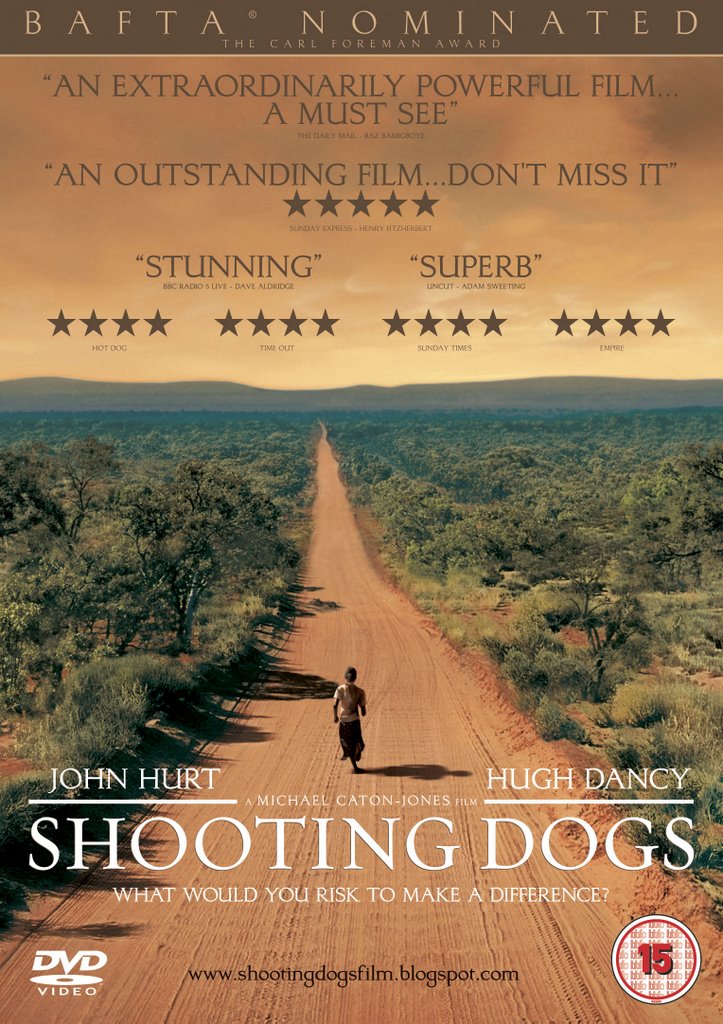
Shooting Dogs


I watched the BBC Films production, Shooting Dogs a couple of nights ago with Alyssa. This was an incredibly powerful retelling of the events of the Rwandan genocide, as viewed through the eyes of an aging Catholic Priest (John Hurt) and a young, idealistic British school teacher (Hugh Dancy).

The film was shot entirely on location on the site of one of the 1994 genocide's horrific massacres - the Catholic Church run Don Bosco School on the outskirts of Kigali.

Where Hotel Rwanda was a fairly slick Hollywood production, shot on location in South Africa, Shooting Dogs is a simpler, yet far more moving and impacting look at the early days of the genocide. In fact, it leaves Hotel Rwanda in the dust as it takes a very personal look at the way the genocide unfolds before the eyes of two, Western observers.

Hurt's character, Father Christopher, has spent 30 years on the African continent yet nothing has prepared him for what he would experience as more than 2000 Tutsi and moderate Hutu men, women and children arrive at the gates of his school within hours of the start of the wholesale slaughter. The school is seen as a safe haven of sorts because it also happens to be the base for a platoon of Belgian UN Peacekeepers.

The name of the film, released in the US under the title Beyond the Gates, is a reference to a scene in the film in which the commander of the Belgian forces tells Father Christopher that his men are going to shoot the dogs which are now steadily consuming the bodies of murder victims outside the gates of the school. A few minutes earlier he had explained to the priest that his own soldiers could not fire upon the militia as they murdered the same people the dogs were now devouring. The UN soldiers "mandate" did not allow them to discharge their firearms except if they were first fired upon.

Highlighting the irony of the situation, Christopher, the priest, asks the question of the commander, "Are they shooting at you?" To which the commander replies, "What are you talking about?". Christopher spits back, "It's just, according to your mandate, if you're going to shoot the dogs, then the dogs must have been shooting at you first!".

The story explores a number of different issues directly - conflict theology, the involvement of the colonials in Africa and the lack of outside international interest in the deteriorating situation. The naivety of Dancy's character is reflected in his response to the unfolding events. The teacher launches an expedition to bring an international media presence (a BBC reporter and cameraman) to the school in the misguided belief this would be enough to avert the slaughter of the people sheltering there.

For me two things stood out the most in the movie. The first was the familiar (to me) streets and landscapes of Kigali city . To see the scenes of the genocide played out before the backdrop of a city I know well was quite an emotional experience. It brought home the reality of the Rwandan experience in a very different way to Hotel Rwanda.

The second was the deeply theological question asked of the old priest by Joe Connor, the idealistic young school teacher. It follows from a particularly harrowing scene in which a young mother and her newly born baby boy are hacked to death by machette wielding Inter'a hamwe militia.

After wittnessing the killing, Conner questions the priest about the human body's response to pain, wondering if there is a threshold beyond which pain is not felt.

Connor says, "You'de think there'd be some ahh, something in the design, you know? Some shutoff valve, if you feel enough pain." The priest answers, "I hope so." Connor replies, "yeah, God knows. Maybe we should ask him, if he's still around?".

The priests answer comes later in the movie in what is probably the most poingniant moment in the whole film.

The UN receive an order to evacuate, leaving the 2500 people they have been protecting to fend for themselves. Connor and the priest are to be among the evacuees, the last of the non-military, white personell in the school.

After boarding a truck with his belongings. Connor looks for the priest and sees him standing, smiling peacefully, in the midst of the people. bbviously not prepared to leave. Connor leaves the truck and runs to the priest, asking him what he is doing. The priest tells him that he is staying. The young teacher stumbles, trying to find the right way to tell the priest that he is unable to stay behind with him and begs him to come.

Connor asks him, "Why are you doing this?". Christopher answers softly, "You asked me Joe, 'where is God in everything that's happening here? In all this suffering?' I know exactly where he is ... he's right here, with these people, suffering. His love is here. More intense and profound than I've ever felt. And my heart is here Joe, my soul. If I leave, I think I may not find it again.".

If I were a reviewer and had given Hotel Rwanda 5 "stars", after seeing Shooting Dogs I would have to drop 2 stars from Hotel Rwanda and give this film 5.

I have only found this DVD in one video store and then only one copy. It might be something you have to ask to be ordered in for you, but the extra effort will be worth it.

The film's website (under the American title) can be viewed HERE.

Saturday, March 08, 2008

Everything Must Change

A new initiative of Brian McLaren, this website is a social networking site with a specific purpose - promoting initiatives and events that are aimed at transforming or changing the world in which we live. It allows users to post promote and network ideas, events, campaigns etc, and sign up to support the initiatives of other users.

Here's what Brian has to say about it:


When I began researching global crises, I was interested in understanding them - but even more, I was interested in discovering what I could become and do in order to make a difference. My research led to a book, and then some friends, and then some friends and I began organizing a speaking tour. Before the tour even began, I began meeting people who said, "I feel the same responsibility and desire and hope. How can I help?" Soon, the idea for this site had emerged - a place where more and more people can become part of this process of understanding, becoming, acting, and joining together
Check it out and sign up to be a part of it HERE!

Tuesday, March 04, 2008

Landlords who care

Homelessness is an issue I face on an almost weekly (sometimes daily) basis. Around 10% of my young charges are homeless at some point during their time with me in Kick Start. I also meet a large number of people of all ages who face the struggles of homelessness on a regular basis.

One of the big issues in my region is a chronic shortage of housing - market rent is at a phenomenal high with the promise of another 5% increase in the next month making it even harder for many first time renters to get into the rental market. Minimum rent is now around the $220/week mark with youth benefits sitting at around $300/fortnight.

Most strugglers, particularly those under 25, don't often even get as far as the application. I visited real estate agents with an 18 year old client late last year and witnessed him being laughed at by property managers who were happy to take his application fee while telling him it was unlikely he would be successful in any application because of his age and lack of "rental history".

As a result quite a significant number of young people are couch surfing - putting a strain on friendships. Others, including whole families, are living in cars, sheds, or just sleeping rough. Emergency accommodation is at breaking point. Services which offer clients accommodation for a strict time period of 3 months are finding they are seeing clients remain in their accommodation for more than 6 months because there is simply nowhere for them to go. Real estate agents have pages of names of waitinglists, making it easy for landlords to simply pick the most desirable tentants every time.

Hostels and back-packers are refusing to take clients from local community service providers because of the large numbers needing a room and the "undesirability" of the clientele. A problem which can be gotten round by lying (something I have done several times now when booking short term accommodation for clients) - simply answering "no, the booking is for me" when asked if it is an agency booking (begs the question "when is it ok to lie?").

Around 6 months ago I was approached by a couple who own an investment property and had heard me talk about the housing shortage. They have a duplex they would like to see used as affordable housing - helping at least a few people to get a roof over their heads. Last week a second couple with an investment property approached me with the same offer.

Over the weekend I was thinking about this. The first couple asked me if I would manage the property for them. I really didn't think this was something I wanted to take on, but it got me thinking about a way of making this work.

I decided to go see a good friend of mine who also happens to be a real estate agent and property manager. He is sympathetic to the cause and has helped me to find accommodation in the past for what would otherwise have been some pretty hopeless cases - sticking his neck on the line in the process.

He was really receptive to the idea of managing properties for landlords who are prepared to be flexible in their lease agreements and are willing to take a less-than-market rent in order to put a roof over someones head. He is also prepared to take on these kind of properties at cost price. While we still have to work out the finer details, I think that we might actually be on to something here.

I am looking at running this through our missional community plant - we have a range of community service workers who are a part of what we are doing - including a guy who works with State Housing tenants who are falling behind in their rent or upkeep of homes (I was going to get around to talking to you about it Shane!!!).

While we might not be able to help everyone, it at least it looks like we might be able to relieve the pressure for some. If you are reading this and have an investment property in the Bunbury area and would like to join in, please let me know. Let your investor friends know also.

Thank God for landlords who care!

Saturday, March 01, 2008

Discipleship in a post-literate culture? Part 1

In looking at this issue I want to start with a couple of important disclaimers.

Firstly, what follows are observations based on personal experience. With this in mind I am perfectly willing to admit they may be peculiar to my mission context - however, as they say, "if the cap fits ..."- if you find something that resonates or rings bells with your context/experience, then please, jump in with some observations of your own.

Secondly, this whole topic is one that I see as being increasingly relevent for the church as a whole as we move into the 21st century and away from the ideals of modernism that were once entrenched in our ecclesiology and culture but which are now quickly falling into irrelevance (again, my opinion - feel free to disagree). Having said this, I want to make it clear that what I am really interested in is the method or practice of discipleship - it is the appraoch the church takes in making and growing disciples that I am calling into question not neccessarily the message we are seeking to impart through the process of discipleship.

I suggested this topic as it is one that I find both interesting and infuriating. Interesting because it represents a challenge I face almost daily and infuriating because of the apparent lack of clarity or open discussion about post-literate, post-christendom, post-modern discipleship in practice in the real world. And the overall lack of available resources dealing with this topic.

I'll start off with a table reproduced by Michael Frost in his article, "Preaching in a post-literate age" as I think it helps shed light on the contrast between the "old" and the "new" in our present culture.

MODERNPOSTMODERN
Things may be provedThings may be probed
Uses science to remove mysteryWelcomes & celebrates mystery
Truth by reasoning (cognitive)Truth by experiencing (emotional)
Go from truth to lifeGo from life to truth
Deals in facts, dogma, conceptsDeals in interpretations, opinions
Uses exact languageUses approximate language
Communicates via technical termsCommunicates via myths, symbols
Sees universe as closed, predictableSees universe open, unpredictable
Values independenceValues Interdependence
Individualised dreamsCorporate dreams
World view determined by what we seeWhat we see is determined by our world view
Objectivity possible: Observer & observed are separatedEveryone is subjective: Observer is part of observation
Beliefs held dogmaticallyBeliefs are open for discussion
Life viewed analyticallyLife viewed holistically
Concerned with what things are (Truth is absolute)Concerned with how things relate (Truth is relative)
There is one way to liveThere are many ways to live

The modern, evangelical church, at least in part because of a shift in culture, has become increasingly irrelevant as a vehicle of the gospel because, while it has been good at the business of theory, it hasn't been great at linking this with practice.

While it may be a generalisation, I think it is an accurate one; the practice of the faith in the majority of modern, evangelical/pentecostal churches can be equated with attending a service on a Sunday, attending an "academic" bible study on a weeknight (or day) and engaging in various church-run social activities at other different times.

You could also throw into this no small amount of pressure put on individuals within churches to "evangelise" their friends by bringing them along to church run or sponsored events where they will have an opportunity to hear a special, evangelistic message.

Now what I have been talking about is the practice of faith within the Christian church. It is the focus or point of the practice of the faith that I believe holds the key in understanding discipleship in the post-literate context and the increasing ineffectualism (did they ever really work?) of the "old" ways of practicising the faith.

I guess none of this is really new. We've debated it for ages, been accused of focussing on negatives, church bashing, or throwing the baby out with the bathwater.

But ...

... I think, if they are completely honest with themselves, most churches know:

1) That their efforts are not as effective in bringing new individuals into the (catholic) church community as they once were and in many cases, actual community engagement beyond the four walls of the church is non-existent.

2) That transferance is the real cause of growth in the churches whose numbers are increasing.

3) That it seems to be increasingly difficult to get any substantial percentage of those attending on a Sunday involved in a more meaningful way, than simply attending the Sunday service or church run social events.

4) That the gulf between the church and community outside its wall's is big - even if this is only acknowledged in the frustration felt from not seeing "new" growth (as opposed to transfered growth).

This is post is starting to get long. I'm going to split it in two (or more bits if I need to). So now I've kinda nutted through the problem (in a very general way), in part 2, I'll try and focus more on my experience with specifics.

This is a synchroblog - If you would like to join in, please let me know and I will link to it and get you to link to other participants.

Synchrobloggers so far -
Glenn Hager - Re-dreaming the Dream
Mmmm, That's Good Coffee

Sunday, February 03, 2008

Positive About the Church - Synchroblog


A facebook friend of mine - Sally Coleman - came up with the idea of making February the 2nd a day for posting positive stories about the local church (sorry Sally, I'm a day late!).

As someone who often grumbles about different aspects of the local church, I was challanged to participate in this synchroblog. One of my new years resolutions this year was to learn to express the positive more often and the negative less often in all circumstances and what better place to start than with my very own local expression of the church.

Our fellowship is one that has been through a lot in recent years. Around 5 years ago we experienced a bit of a split when all the young families left to attend a mega-church in nearby Bunbury. This left Alyssa and I as the youngest in the congregation by about 10 years.

There were problems with the leadership at the same time which saw a few more leave along the way. In the end we were left with a shell of about 15 regulars, the majority already well into their senior years, conservative, old fashioned but completely committed to Jesus and to being the only expression of the local church in our community.

Around 3 years ago I took over the pastoral role in the hope that we could take things in a more missional direction, changing from what until then had been a very "believer centred" church and into something that was focussed and committed to the broader community in which it existed.

What we saw in the ensuing 3 years was an amazing period of personal and spiritual growth as a group of older people (and I was always told "you can't teach old dogs new tricks") began to explore what it meant to be a decentralised, disinstitutionalised, community serving expression of faith. To break with long held traditions and even to begin to question core doctrines that had been held to faithfully for decades without question and to allow God to work in us and in our lives and through us through serving the community outside the comfort and safety of our meeting place.

While to the casual observer, looking in from the outside, we probably still look a lot like a conservative, dying church in a growing suburban community, the reality though is something very different.

I am so very proud of the people I call my brothers and sisters (even though most of them are actually old enough to be my parents and grandparents) and the way they have allowed the message of Jesus to challange them and change them and change the corporate and personal foci of their faith.

We are still growing and the journey is far from over, but already I know this community is in a better place because of the presence of the local church within it - as an active part of it - rather than as an enclave on its edge. And for the way in which a bunch of older people have completely challanged the stereotype of stayed, unchanging, evangelical conservatism, becoming instead more and more the salt and light in the difficult missionfield of affluent suburbia.

Saturday, January 26, 2008

Kenya - Another story

As is so often the case, the true extent of the violence and suffering is often not the same as that seen on the television news and is often not more fully known or understood until well after the events have taken place - think Rwanda.

Through my work with Day 4 I am involved with a ministry - City Harvest - which works among the slum dwellers of Nairobi, improving living standards, training and providing access to retroviral medication and AIDS/HIV clinics. When the violence broke out in Nairobi at the start of January I knew that Edward Simiyu and his team would be affected and would also be involved at the heart of the relief effort. With this in mind we launched the Day 4 Kenya Appeal to raise funds to send to City Harvest to use in the relief effort.

The reports we have been receiving from Edward paint a picture of disaster that is much more wide spread than that seen in much of the media reports coming out of Kenya in recent weeks. More than half a million men, women and children displaced from their slum communities and left without food, water, clothing, shelter or security. To the north of Nairobi homes, schools and churches have been destroyed and many people killed.

2 weeks ago Edward and a number of other local Christians embarked on a journey through roadblocks manned by armed youth - bent on violent retribution in what many in Kenya have likened to the early days of the Rwandan genocide - in order to supply humanitarian aid to those in remote areas, unaccessible to most other relief organisations.

Edward's report of the convoy's journey paints a picture of corruption, disaster and dispare. The military, sent to help those affected by the indiscriminate violence, were demanding money in exchange for protection, schools churches and homes were looted, ransacked and burnt and bodies left to rot where they lie, providing a source of food for scavenging dogs.

Here are some photos from the road to Eldoret.

Refugees sleeping in the opening with all their belongings in plastic bags

All that remains of Kondoo Shopping Centre

Wrecks of elite forces vehicles, sent in to stop the violence. The troops were repelled and then their vehicles burnt and thrown into the river.

The remains of Kamuyu Primary School - looted and destroyed

All that's left of an AOG church looted and stripped back to the frame

One of many homes completely destroyed - more can be seen in the background

The remains of Eldoret church where many people died after seeking refuge from the violence. The church was torched.

The situation in Kenya is dire. Please continue to pray for this country and its people. Please also consider linking back to this blog post and promoting the Day 4 Kenya Appeal on your blogs. 100% of funds donated will make it to Kenya to be used specifically for the relief effort. Please also consider donating - response to the appeal has been slow, yet even small donations add up and can make a big difference to the suffering in Kenya.

I'll leave you with some words from Edward and thanks again for promoting and praying and donating!

Please pray for Kenya. The suffering and damage is more than what the media has highlighted. More churches have been destroyed than those counted and reported. More churches are likely to suffer the same fate with the precedence now set should unrest continue. The dead are still unaccounted [for] and we are all likely to die if unrest continues. Prices have shot up and calm that was returning is threatened by uncertainty especially this week as more rallies are planned for Wednesday to Friday. They are never peaceful. Two of our HIV/AIDS support group members had their houses torched and are still in trauma. A number ran out of the life prolonging ARVs and now have to change their line of drugs.

Friday, January 25, 2008

Am I "Anti Church"?

I had a rather frustrating conversation with a good friend earlier in the week. It arose because of assumptions this person seems to keep making about my opinions on the issues of "church" and "mission".

It's something that has kept cropping up over the past year or so and usually ends with me consistently trying to reassure this person that I think believers meeting together to learn, worship, pray and fellowship and that people travelling overseas for "mission" are really important. As someone both employed by a local church, involved in leading and teaching in a Sunday meeting and also heavily involved in overseas mission in Central Africa I've found the assumption that I am against both these things in some way or another to be incredibly frustrating.

It all came to a kind of head at the start of the week. Instead of dancing around the whole thing like we usually do, I came out and simply said "I don't know why you think I am against Sunday meetings and overseas mission. In fact I don't see how you could even think that I would be against these things given my involvement in both."

She responded by saying that I kept saying we needed to forget about these areas and focus more on other things so I obviously was anti both. The conversation ended at that point and I was left feeling bewildered.

I was talking about it with Alyssa later on when Alyssa hit on an important detail we had overlooked - something I regularly say when discussing these things is "we need to put Sunday church to the side and focus on the other days of the week" or "we need to put overseas mission to the side and focus on the missionfield at home for a bit".

What Alyssa pointed out was, what I mean when I say these things is, "we need to elevate the other 6 days of the week and things we do on those days to the same level of importance we give Sunday's" and "we need to give mission at home the same level of importance we give mission overseas".

But instead of hearing this, my friend - and quite possibly others also - was hearing, "I don't think Sunday meetings and overseas mission are important and we should just leave them to one side and concentrate on other things".

Another clear example of the confusion which can be caused by not communicating clearly. All I have to do now is work out how widespread these sentiments are so I can hopefully undo any damage I've done and reassure everyone I am not anti church!